Orphaned Lineage



Like many of you reading, my birth family is not always my safe space. Family time often brings a mix of emotions—gratitude, the comfort of togetherness, but also discomfort as old wounds surface, perpetuating subconscious behavioral patterns. Family time is a lot. I know I’m not alone in saying this.
The holiday season, in particular, tends to be tumultuous for most. But could this be the year I finally relax into the discomfort, embracing it as a powerful tool for healing our lineages? What if this discomfort is exactly what we need to reach new levels of healing and awareness—as a lineage?
Thanksgiving really kicked things off with a bang for my extended family. A lot came up around expectations, emotions, and boundaries. It felt like uncomfortable feelings were being kicked up from a dusty corner of the room—one that had gone untouched since we first moved in.
But just like cleaning those unseen spaces can positively shift the energy in your home, those uncomfortable family conversations can heal you. They can heal entire lineages.
The Importance of Resting
This is the first year in a long time that I’ve sat out of my family gathering. It’s a big deal for me. Thanksgiving is one of only two times a year I really see my grandmother, and it’s so important to my mom, whom I love dearly. But this year, we needed rest. I’m grateful we overcame our fear of disappointing others and chose what was best for our family. It paid off, and we’re feeling so much more resourced.
Taking this time to rest also gave me the opportunity to reflect on what Thanksgiving really means. I understand the older generations’ perspective of it as an innocent time to gather in gratitude over a meal. For them, that’s been their reality their entire lives. But for me, I also know the truth: it’s a colonialist celebration of the genocide of Native American peoples. For many descendants of colonizers, Thanksgiving marks the day we feel disconnected from our culture, land, and ancestral ways of living.
I believe it’s a time to come together in grief and prayer for our collective loss.
Honoring Indigenous Peoples
For our little restful Thanksgiving at home, we decided to read the Haudenosaunee Thanksgiving Address. It felt so right. We wanted to honor life with the indigenous peoples of this land. Because, really, what wraps a warm hug around grief more than gratitude?
Reflecting on My Childhood, Ritual, and Values
As I sifted through the latest family drama, reflecting on my feelings about spending holidays at my parents’ house, I also pondered my childhood, ritual, and values.
Starting with emotions: my childhood didn’t feel good. While there were good moments, the overall vibe was one of discomfort, feeling unimportant, and undernourished. I don’t want that for my daughter’s childhood.
I believe what led me to feel this way was a lack of belonging. There were no clear expectations or opportunities for me to participate meaningfully in my family. I often felt like a nuisance, like I was in the way and making everything worse. So, how do we invite children to participate in ways that feel nourishing and meaningful?
I’m still digesting the answer, but honesty and ritual are two key aspects I’ve been exploring. Honesty is about talking openly about the hard things—things we often suppress. As a child, when adults didn’t talk to me about the tough stuff, I internalized a sense of being bad or wrong when those things came up for me. And then there are the big, hard truths—like the genocide of Native American peoples—that continue to be swept under the rug. I want to be honest with my daughter about all of it so we can grieve together. Families who grieve together heal together.
The magic of Ritual is something I can’t fully dive into here, but I highly recommend listening to The Emerald Podcast for a deeper exploration on the history and meaning behind ritual. Rituals are so nourishing for lineage—they create a rhythm for our spiritual selves. They are something we return to, time and again, with reverence. Rituals are how culture is passed through generations. Isn’t that incredibly magical?
So what are the meaningful rituals of my family? When I reflect, there are not many, and the few there are, I’m not particularly interested in continuing….
The Orphaned Lineage
Now, I won’t go into the details of my current family drama, but I will share this: My family is suffering deeply from a disconnect to elders, ancestors, culture, and lineage.
I come from an orphaned lineage. My mom was adopted and knows nothing about her birth family. So, everything her animal body remembers ancestrally—she has no wise elder to hold her in. Let that sink in.
And then there’s the greater loss I mentioned earlier. When European settlers crossed the ocean, they split from their elders—both human and plant. No wonder our culture suffers from overconsumption. We’ve all been trying to fill a huge, gaping hole.
I feel like most of us have never really grown past this loss.
We have elders with beautiful medicine, but they are not lineage wisdom keepers. They have not walked through the fires of initiation tied to thousands of years of ancestral wisdom.
Becoming the Elders We Need
So, what’s a family with no initiated elders to do?
You become one. You walk through the fires of initiation with reverence and pray to those who walked before you to show the way.
We can all agree that collectively, we’ve gotten lost. The time of colonization is over. It’s time to rewild and reroot into the ancient wisdom that lies before us.
It’s time to step up and be the elders we crave. And at the risk of sounding “unhumble,” I’ll proudly say that I’m on that path.
My husband and I are accepting challenges, softening into growth, and blooming into the matriarch and patriarch our lineage needs. The ones our ancestors have been praying for. The ones we all deserve.
It’s hard work. Facing brutal truths. Softening sharp edges into the magic of nuance. Admitting when we’re wrong. Being both a leader and a follower. Letting love in, even when it hurts.
But we’re doing it.
And the rituals we create, the foundation we lay, will nourish our lineage for generations to come.
Creating a Culture of Belonging
We do this work because it makes the world a better place for our children.
We are all coming home to belonging.
I plan to co-create a culture of belonging in my home—one that gives my daughter a sense of place. I pray to give her what she needs to fill this gaping hole in our lineage, a hole we’ve tried to fill with consumption—sugar, alcohol, and gifts—this time of year.
I plan to gift her magic: storytelling, seasonal crafts, spiritual meaning, and, of course, hot cacao.
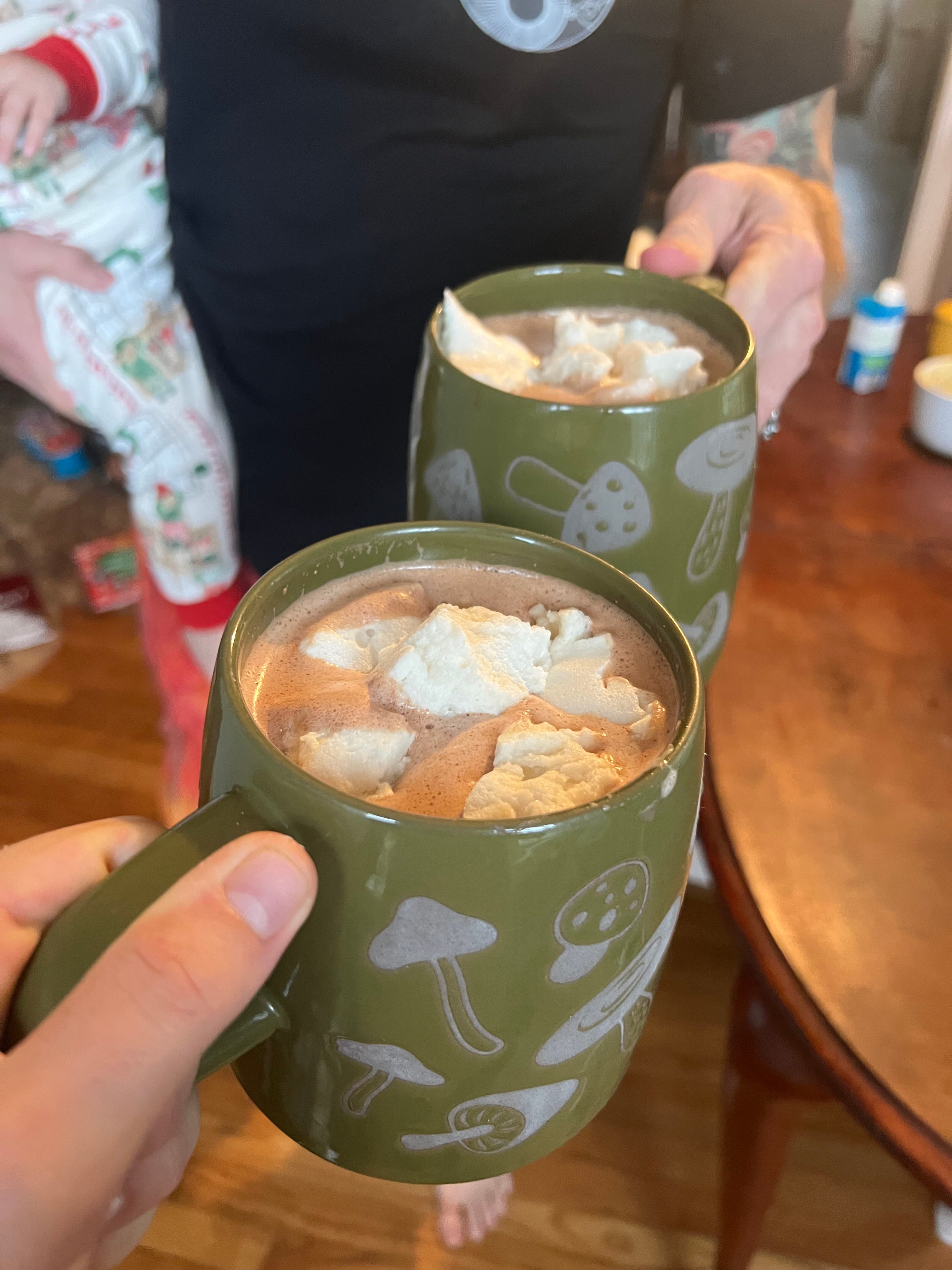
Bone Broth Hot Chocolate: Three Magical Recipes to Nourish You Through the Holidays
Spiced Beef Bone Broth
Ingredients:
• Beef bones
• Filtered water/spring water (the quality of your broth depends on the quality of the bones and the water)
• 3 tbsp apple cider vinegar (ACV)
• Toasted cardamom (regular powdered cardamom is fine, but toasting the whole seeds yourself enhances the flavor)
• Cinnamon
• 3-4 whole star anise
• 2 inches of ginger (cut into pieces)
• Black pepper (whole peppercorns, toasted for a richer flavor)
• Salt
Instructions:
1. Roast the Bones: Preheat the oven to 425°F (220°C). Roast the beef bones for 25 minutes, flipping them halfway through.
2. Prepare the Broth:
• Place the roasted bones in your pot.
• Generously coat the bones with all the spices. For beginners, start with 2 teaspoons of each spice. Add the ginger pieces.
• Fill the pot with filtered or spring water, just enough to cover the bones. Avoid too much water, as it can dilute the broth’s flavor.
• Add the apple cider vinegar and bring the pot to a boil.
• Once boiling, lower to a simmer, cover, and simmer on low heat for 8–12 hours. After 8 hours, top up with more water if needed.
3. Strain and Enjoy: After simmering, strain out the bones and spices. Enjoy the broth as a warm drink or use it as a base for soups.
Storage:
• Fridge: 3–5 days
• Freezer: Up to 6 months
Hot Cacao
Ingredients:
• Milk of choice (whole milk is preferred)
• Cacao (ceremonial grade is ideal, but any chocolate that melts works)
• Honey or maple syrup (to taste)
Instructions:
1. Prepare the Broth:
• Fill your mug or mugs about 2/3 full with the spiced beef broth.
• Warm the broth on the stovetop and melt in the cacao (about 3 tablespoons per cup, but check the cacao packaging for specific measurements, especially for strong ceremonial cacao).
2. Prepare the Milk:
• In a separate pot, warm your milk and froth it using an immersion blender (this tool is a game changer for frothing). Alternatively, use any frothing method you prefer.
3. Assemble the Cacao:
• Pour the chocolate-infused broth into the mug(s), topping with frothed milk.
• Stir well, adding any medicinal tinctures like reishi or milky oats.
• Sweeten to taste with honey or maple syrup.
Herbal Marshmallows
Ingredients:
• 1 tablespoon marshmallow root powder (or any other herbs you prefer)
• 1 cup water (split into two ½ cup portions)
• 2 tablespoons grass-fed gelatin powder
• 1 cup raw honey
• 1 teaspoon vanilla extract (optional)
• A pinch of sea salt
Instructions:
1. Infuse the Marshmallow Root:
• Simmer ½ cup of water with marshmallow root powder for 5–10 minutes.
• Strain the liquid and allow it to cool slightly.
2. Bloom the Gelatin:
• Sprinkle gelatin over the remaining ½ cup of cold water and let it bloom (absorb water and become spongy).
3. Create the Syrup:
• In a saucepan, combine the honey, the strained marshmallow root infusion, and a pinch of sea salt.
• Heat over medium heat until the mixture reaches 240°F (soft ball stage) on a candy thermometer.
4. Whip the Mixture:
• Slowly pour the hot syrup into the bloomed gelatin while mixing with a hand or stand mixer on low speed.
• Increase the speed and whip for 10–15 minutes until the mixture becomes fluffy and forms stiff peaks.
• Add vanilla extract in the last minute of whipping, if using.
5. Set the Marshmallows:
• Pour the mixture into a greased or parchment-lined 8x8-inch pan.
• Let it sit at room temperature for 4–6 hours, or until firm.
6. Cut and Coat:
• Dust the marshmallows with arrowroot powder or tapioca starch to prevent sticking.
• Cut into desired shapes and coat all sides.
Storage:
• Room Temperature: 1–2 weeks
• Refrigeration: Up to 3 weeks
I pray these recipes bring magic and nourishment into your home this holiday season.
Try this recipe? Relate to these words? Please comment, let’s connect.
With love,
Hara Maria
🤎 That recipe though!
Feeling these sentiments so deeply as I also chose to rest this thanksgiving and simply not consume the propaganda that is being fed to us.
This was a nourishing read, thank you!